

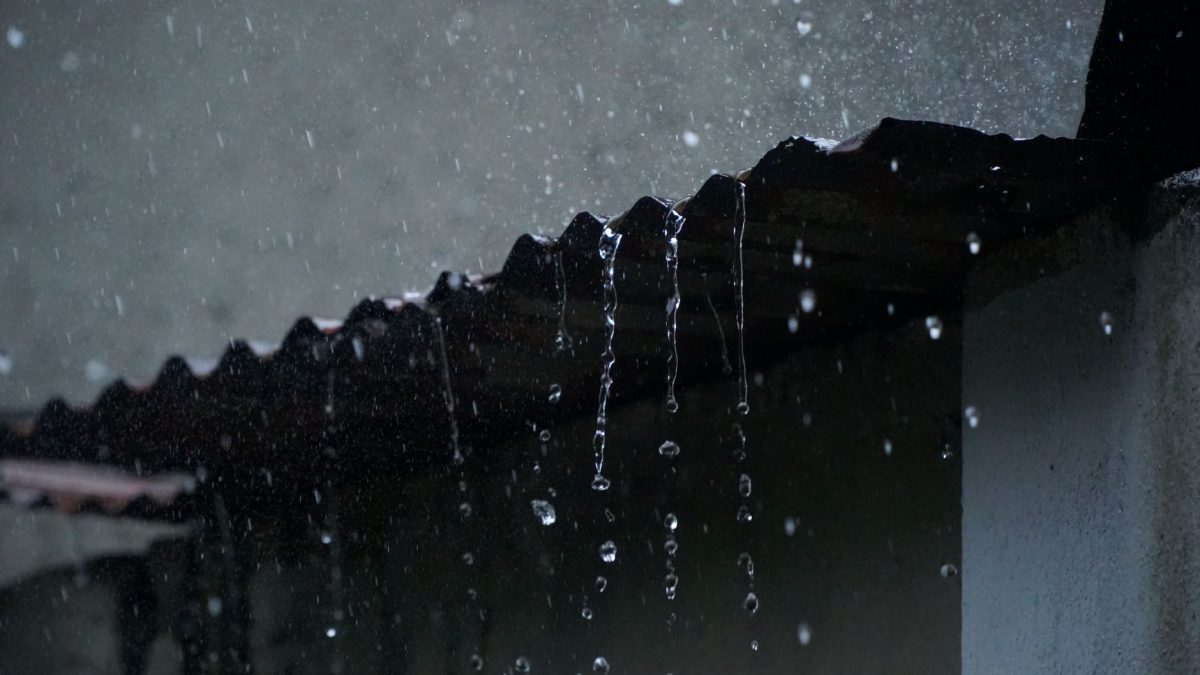
Roof runoff management in dry climates should direct stormwater to a suitable destination that protects buildings, preserves access, and avoids creating problems downstream. Depending on the site, that destination might be an approved drainage route, a designed landscape basin, or a storage system with overflow. The right choice depends on grading, soil, available space, and local requirements.
Dry weather between storms does not make the water disappear when rain arrives. A roof collects it quickly and sends it toward a relatively small number of edges and outlets.
Follow the water through the whole property
A useful runoff plan connects four stages: the roof collection area, the gutter or roof outlet, the downspout or conveyance route, and the receiving destination.
Stopping at the bottom of the downspout leaves the most consequential question unanswered. Water that lands on paving may flow toward an entry. Water that lands in gravel may collect on compacted soil underneath.
The National Weather Service's hydrology guidance identifies soil characteristics and slope as factors affecting runoff and infiltration. A dry-looking yard therefore needs assessment rather than an assumption that it will absorb whatever the roof delivers.
Estimate volume without confusing it with capacity
The University of Arizona Cooperative Extension describes a simple estimate: roof collection area in square feet multiplied by rainfall depth in inches multiplied by 0.623 gives the approximate gallons falling on that area.
For a hypothetical 1,500-square-foot horizontal collection area, one inch of rain represents about 935 gallons before collection losses. That helps homeowners understand why a small container may fill quickly.
The estimate does not size gutters, pipes, or overflow outlets. Those components must handle a flow rate, which depends on rainfall intensity and the actual drainage arrangement.
This distinction also matters when discussing storage. A large-looking tank may provide useful irrigation water but still need an effective overflow route once it fills.
Consider three possible destinations
A suitable surface drainage route
Some properties can discharge onto a stable, appropriately sloped area that carries water away from buildings. The route should avoid obstructing pedestrian access or causing erosion.
Check the full path, including what happens at the property boundary. Moving water away from one house is not a complete solution if it creates a problem next door.
A designed landscape capture area
Passive rainwater harvesting uses landscape features to receive and distribute runoff. A suitable basin can support planting while slowing water movement.
Its location, capacity, soil conditions, setbacks, and overflow need assessment. An improvised depression beside the foundation is not equivalent to a designed capture feature.
A storage system with planned overflow
Active harvesting stores water in a tank or cistern for later use. Inlets, screening, access, intended use, and overflow should be included in the design.
Roof runoff should not be assumed safe to drink. Any intended potable use requires a separate assessment of collection materials, treatment, and applicable requirements.
Make the roof-to-ground transition deliberate
Downspouts should be positioned to serve both roof collection and the selected destination. Several outlets feeding one small receiving area can overwhelm it even if each gutter is working.
Southwest Seamless Rain Gutters describes downspout and leaderhead services for Arizona and Southern Nevada. When reviewing a proposal, homeowners should ask how each outlet fits the broader runoff plan.
A buried drain can be useful on a constrained lot, but its destination and cleaning access should be known. Do not connect to a foundation drain or an unidentified underground pipe on the assumption that any buried route is appropriate.
Check restrictions before changing the route
Local requirements, drainage easements, association rules, and approved site plans may affect where runoff can be directed. Ask the relevant local authority or qualified designer before making changes that alter off-site flow or connect to public infrastructure.
A gutter installer can assess collection and exterior conveyance. A project involving significant grading, shared drainage, or uncertain soil behavior may also need a civil, landscape, or geotechnical professional.
Homeowners planning new collection equipment can compare seamless gutter installation services once the discharge approach is understood.
Test the plan against a full system
Ask what happens when the storage tank is full, the landscape basin has received water, or one inlet is blocked. A useful design includes a safe overflow route and access for maintenance.
After rainfall, observe from a safe location and record where water actually moves. Erosion, unexpected ponding, or flow returning toward the house can reveal assumptions that need correction.
Decide whether the goal is disposal, reuse, or both
Start by identifying what the homeowner wants the runoff plan to accomplish. Keeping water away from a doorway, reducing erosion, and collecting water for later landscape use may require different arrangements.
A storage system can contribute to reuse while still needing a reliable route for water that cannot be stored. Similarly, a landscape basin can receive runoff without replacing every drainage feature on the property. State the purpose of each component so one feature is not expected to solve unrelated problems.
For a hypothetical home with limited side-yard space, a tank may seem appealing because it contains water in a defined footprint. The planning discussion must still address access, maintenance, suitable use, and overflow when the tank is full. If those questions cannot be resolved, another destination may be more appropriate.
Compare options using the same site information. An assessment of grade and available space should inform the choice before products are selected.
Create a maintenance plan for the receiving destination
Roof collection equipment is only part of what needs attention. A receiving area can be altered by accumulated debris, landscape changes, moved extensions, or work by other contractors.
Record what the selected destination is intended to do and how it can be inspected. If water enters a storage system, keep the operating and cleaning instructions available. If it follows a surface route, mark the features that need to remain unobstructed. For underground conveyance, retain information about the outlet and access points.
After changes to paving or landscaping, compare the finished site with the runoff plan. A new border, planter, or path may alter where water collects even though the roof and gutters remain unchanged.
Keep observations specific. Note whether water reached the intended basin, bypassed an inlet, or appeared at an unexpected outlet. That record is more useful than a general statement that the yard flooded.
If the system repeatedly needs emergency intervention during ordinary property use, ask whether the layout is practical to maintain. A workable plan should account for how residents actually use the site and how service personnel can reach the components. That makes ongoing performance part of the selection process rather than an afterthought.
Runoff questions
Can roof water simply drain into gravel?
Sometimes, but gravel alone does not establish infiltration capacity or a safe route. The underlying soil and grade matter.
Is rainwater harvesting always the best solution?
No. It must suit the site, intended use, maintenance capacity, and applicable requirements.
Can gutters control water arriving from the street?
They manage roof runoff. Water entering from outside the property requires a separate site-drainage assessment.