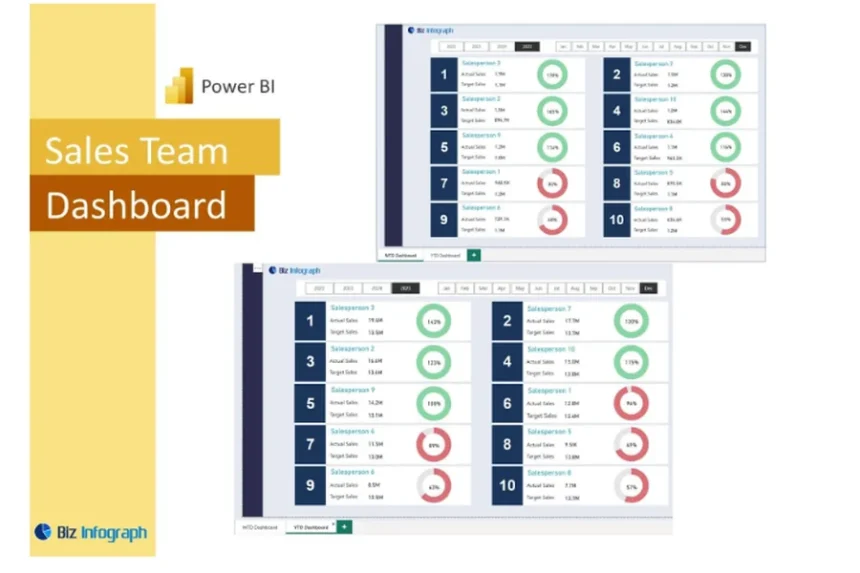
The Significance of Monitoring Sales Team Performance
In the paced world of sales teams where goals and deadlines crystal clear tasks not only involve setting objectives but also monitoring progress and fine tuning strategies constantly for success to thrive Tracking performance is crucial for organizations to evaluate both individual and team efforts spot strengths and weaknesses and adapt tactics in the moment. Without a clear view, into how sales teams are doing managers must rely more on gut feelings rather, than concrete data
Exploring the Capabilities of Power BI in Providing Real Time Sales Analysis.
Sales team dashboard in Power BI offers a foundation, for creating dashboards that bring together data from various origins to give a comprehensive overview of sales performance from every angle imaginable. With its advanced data modeling features and visualization tools along with automation functions it serves as the choice for sales professionals looking to monitor metrics such, as sales revenue trends sales team activity levels, sales conversion rates and the performance of individual representatives—all conveniently found in a single location.
Exploring the Role of a Dashboard for Sales Teams
The main objective of a sales team dashboard is to monitor and display performance metrics in a manner that aids in making decisions effectively. A designed dashboard should include.
Metrics essential for tracking in a sales team dashboard.
Sales Objectives for Individuals and Teams Compared to Performance
Monitor sales progress, in relation to set targets utilizing bar graphs or column charts to contrast revenue with goals, on both team levels while key performance indicator (KPI) cards can display overall accomplishment rates.
Rates of conversion and advancement, in the sales pipeline.
Keep an eye on how many leads turn into customers and track the progress of each step, in the sales process funnel! Divide the sales pipeline into segments like leads or successful closures to see where things are going smoothly or getting stuck along the way.
Key Performance Indicators (KPIs); Phone Conversations, Face, to Face Gatherings, Product Demonstrations
Track signs such, as the volume of calls completed or scheduled meetings to gauge productivity levels and assess the effectiveness of sales representatives. Make sure to get your information, from your CRM system such as Salesforce or HubSpot or Dynamics 365 and export details like opportunity data and activities along with contact information and different stages in the process. Remember to have identifiers, like Representative ID (Rep ID) Opportunity ID and the Date included in the export file.
Crafting leaderboards and performance scorecards.
Show charts that rank sales representatives based on measures, like performance metrics. Highlight the 10% bottom 10% or reps who are, below their sales target. Use color coding to emphasize these rankings. Scorecards containing Key Performance Indicators (KPIs) such as number of deals closed deal value and frequency of activity enable comparisons.
Enhanced Functions for Better User Experience
Individualized Sales Representative Insights
Users should be able to click on a representative’s name to access their personal performance page where they can view sales goals along, with detailed breakdown of pipeline stages and past performance data.
Arranging Updates. Activating Notifications
Establish weekly update schedules, within Power BI Service to ensure that the information remains up to date and set up notifications for metrics (such, as alert notifications when a sales representative achieves 90 percent of their target) to inform users through email.
Guidelines for Introducing Dashboards to Users
Ensure that it can be put into action and understood easily.
Limit the amount of data you include to prevent overwhelming the audience with information overload. Organize your performance indicators (KPIs) in a manner and group related visuals together. Enhance the clarity of visuals by incorporating tooltips and providing titles that make them easy to understand. Include explanatory insights text, in sections as necessary.
Customize perspectives based on positions.
Not everyone requires access, to all information at once, in Power BI—utilize role-based security (RLS). This way executives can access an overview while representatives are limited to viewing their specific data sets.
Teach sales professionals how to utilize the dashboard
Lead training sessions to demonstrate to teams how to navigate and understand the dashboard effectively urging representatives to utilize it in pipeline evaluations or individual meetings as frequent use fosters acceptance, among users.
In summary
Using a sales team dashboard, in Power BI fosters transparency and accountability while enhancing performance across the board! Managers can offer coaching sessions to their reps who in turn remain focused on their goals; this boosts executives trust, in the data provided by the tool—it’s not just a reporting mechanism but a valuable strategic asset. Bizinfograph offers ready-to-use dashboard templates on Finance, Sales, HR and Manufacturing.