

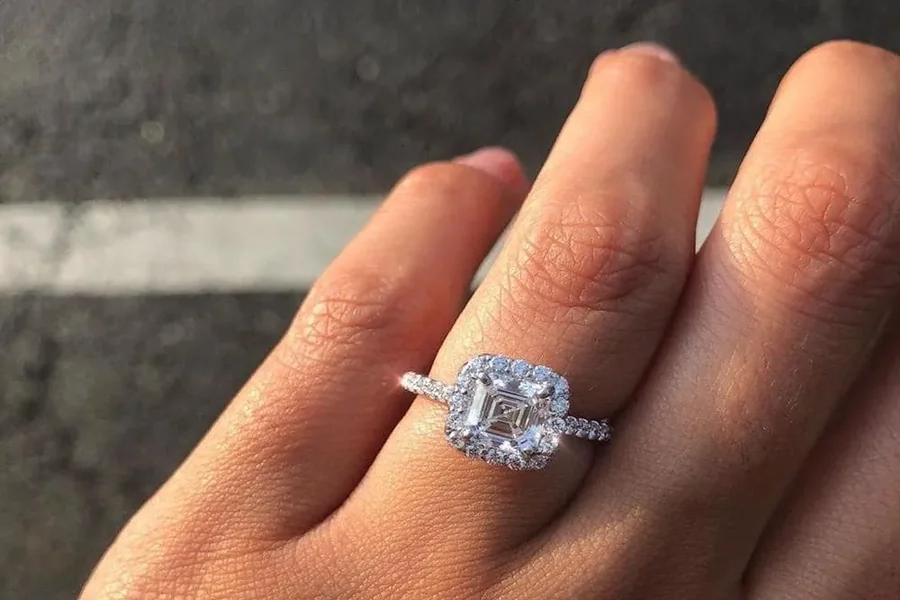
You want the stone in real life to match what you see online. So start with the visuals: good photos and videos let you see the pattern from the top, the symmetry, and how the stone reacts when it moves. If you’re browsing via royalasscher.com, you can first filter by how it looks in photos and video, and only then bring weight and price into it. That’s often faster, because your eyes immediately tell you what feels right and what doesn’t.
Start with the face-up look, not the carat weight
With an Asscher, it’s all about a crisp, calm pattern that builds toward the center. The face-up look (from the top) shows that right away. Online, video and multiple images do most of the heavy lifting here: you see how the stone “comes alive,” instead of just one frozen moment.
When it’s moving, pay attention to what you personally like: does the center stay bright and open, or do you keep seeing the same dark area coming back? And do the step facets on the left and right look equally wide and straight, or does one side look busier? Once you know what you’re seeing, choosing becomes much less of a gamble.
Carat comes after that. Because of its shape and proportions, an Asscher can look smaller than other cuts with the same weight. That’s why photos and videos give you a more realistic sense of how large it looks from the top. If your priority is “looks big on the finger,” deliberately look beyond carat alone. If you’re going for clean and understated, a slightly smaller-looking Asscher can give exactly that calm look.
Cut quality: you’ll see right away what works
An Asscher shows a lot. Because of the larger, open facets, photos-and especially video-quickly reveal whether the lines and proportions are right. A strong Asscher looks calm and controlled: facet lines stay crisp, and the pattern changes evenly as the stone turns.
Video usually makes it immediately clear whether:
– the facet lines stay sharp (clean and well-defined)
– the pattern stays symmetrical in motion (left and right respond the same)
– dark areas move along and don’t keep “sticking” in the exact same spot (which often looks more pleasant)
Also keep the lighting in mind. Warm light can make the stone look softer; cool light can make it look crisper. If you only see one photo, little movement, or visuals that look overly “produced,” ask for or look for extra video. A short rotation from the top and at a slight angle from the side often gives more confidence than one perfect snapshot.
Clarity and color tone: what you can best check online
With an Asscher, small characteristics can stand out sooner-especially if they’re closer to the center. Color tone can also come across differently online than in real life: on a white background a stone can look cooler, while in warm indoor light it can look warmer. Multiple images help you place that better, as does certificate information if it’s available.
What’s often immediately clear online is:
– roughly where any characteristics are (closer to the center or more toward the edge)
– whether characteristics are backed up by a certificate you can view
– whether you see the stone in more than one lighting situation
If you’re sensitive to color differences, put two options side by side with comparable visuals. You’ll spot subtle differences faster. Extra video in different lighting helps too: then you’re basing your choice on what you actually see, not on how one photo happens to turn out.
Setting, service, and returns: peace of mind also comes from what happens after
An Asscher has corners; in a ring, it’s reassuring if those are well protected. Photos of the ring and setting usually show quickly whether the corners are properly secured. Also look at the height: a higher setting can look beautiful, while a lower setting often looks and feels calmer for many people-useful if you work a lot with your hands. Checking this upfront helps you choose something that fits your day-to-day life.
Also look at what’s arranged around your purchase. Clear information about returns or exchanges, options for maintenance or adjustments, and the ability to speak to someone who can look along with you in plain language all add extra certainty. That way it stays straightforward-while you’re choosing and afterward, too.