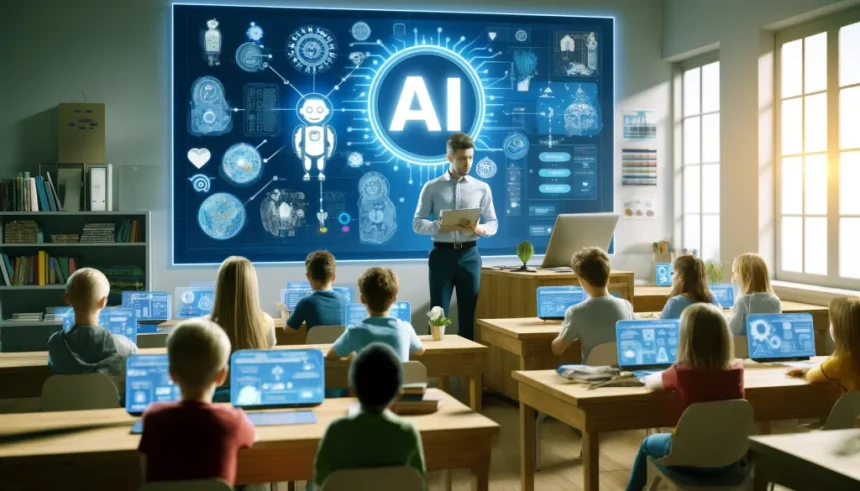
Artificial intelligence (AI), as it grows in popularity, has applications that go beyond learning and into ensuring academic integrity. AI content discovery tools are becoming an important resource for educators in identifying AI-generated content within student submissions. This article discusses the role AI is likely to play in discovering educational content, the tools currently used by teachers, and what AI’s future holds in education.
The integration of AI in education has brought about various benefits but has also raised questions regarding academic integrity. It is crucial that students are encouraged to participate in learning activities, as AI content detectors can help educators identify AI-generated tasks. This paper examines the reasons for understanding AI content, the tools that teachers use, and the impact of this technology on the future of education.
What Is AI Content Detection?
AI content detection is the process of identifying when artificial intelligence is present in a piece of content. As it becomes increasingly difficult for humans to differentiate between AI-generated and original work, this is usually done using AI detection tools like BypassAI IO.
Search engines create a score using machine learning algorithms and natural language processing techniques to determine whether the text is generated by AI or is original.
Why Do We Need AI Content Detection in Education?
There are two main reasons for bringing AI into the classroom: AI is ubiquitous, and it comes with serious risks. Below, we explore these issues in more detail.
AI is Everywhere
Implementing technology in the classroom carries significant risks. We will explore these issues in depth below.
Artificial Intelligence and Education
When one thinks about the use of AI for education, they may assume that students will use it primarily to assist with their homework. However, teachers are also getting involved in the AI revolution.
Here are some ways AI can be used in the classroom:
- Automated Work: Checking homework, filling in forms, writing essays and presentations, grading exams.
- Improving Accessibility: Multilingual-assisted translation and real-time subtitles for the hearing impaired.
- Supervised Testing: Keystroke analysis targeting students using webcams, microphones, and browsers.
- Content Generation: Students can create content to assist with their assignments, generate lesson plans for educators, provide resources for students of different reading levels, and even recommend letters for college.
AI can be used in the classroom to achieve real educational benefits. However, like everything else, AI has its limitations. To avoid major issues, it is important that teachers and students are aware of AI content. AI content recognition is a valuable tool in this regard.
What Are the Risks and Limitations?
While artificial intelligence has its place in education, identifying AI-generated content is essential for responsible use in the classroom. Teachers and students are at risk if they cannot distinguish between AI-generated and original work.
Plagiarism, cheating, and other forms of academic dishonesty are not new issues in education. However, AI makes it easier for students to cheat, which can have serious consequences for both schools and students.
AI is trained using data sets and may detect biases, even unconscious ones. AI-based grading might give some students unfair advantages or result in curriculum recommendations that reflect stereotypes.
AI is not immune to error. A concern is the phenomenon of “hallucinations,” where AI produces information that is inaccurate or has never occurred.
These limitations can have a far-reaching impact on students’ futures. AI content recognition in education is not just a “nice to have”; it is essential.
What AI Detectors Do Teachers Use?
Teachers use AI detectors such as Turnitin, Copyscape, and BypassAI to detect AI-generated content within student submissions. These tools compare text patterns to databases and analyze them to ensure originality and uphold academic integrity.
- BypassAI IO: An advanced tool designed specifically for educational environments that transforms AI-generated content into human-like content. BypassAI IO uses sophisticated algorithms to ensure the output is unrecognizable from authentic text, helping students maintain academic integrity.
- Turnitin: A favorite plagiarism checker among teachers, Turnitin recently released its AI plagiarism detection feature. Teachers can upload their assignments as usual, and the AI will identify both AI-generated material and plagiarism.
- Winston AI: The Winston AI Detector provides a high-precision tool to detect AI-generated content within learning environments. It boasts a 99.98% accuracy rate and assists teachers in addressing challenges posed by AI-designed academic programs.
- Originality AI: A cutting-edge AI authoring platform that offers AI content detection tools and recognition capabilities, allowing teachers to verify the authenticity of their students’ work.
- Copyleaks: One of the most popular AI detectors on the market, promising 99.1% accuracy in detecting AI-generated content. It is user-friendly and can be accessed online, though a free account is necessary to increase the daily limit. A Google Chrome extension is also available for free use.
The Future of AI Detection in Education
AI identification techniques will evolve as AI technology advances. Here are a few future trends to watch:
- Advanced AI Models: Future AI models will likely be better at mimicking human content, making detection more challenging. Detection tools must adapt to keep pace with these trends.
- Integration with Educational Strategies: AI detection tools will likely be integrated with other academic strategies and learning management systems (LMS) for seamless discovery.
- Improved Reporting: Teachers will be better equipped to recognize and act upon evaluation results with enhanced control and reporting tools.
AI content detection can help mitigate the risks in education.
Teachers face the challenge of distinguishing between AI-generated material and student work in today’s technology-driven environment. By managing this gap, they can acknowledge AI’s limitations and ensure responsible use in the classroom.
For example, when a teacher uses the BypassAI IO tool and determines that there is an 80% probability that a student’s paper was generated by AI, they can choose from several options. The teacher may decide to let the student fail and not complete the original task or provide a second opportunity for the student to complete the task independently. This approach helps maintain academic integrity and ensures students are learning and demonstrating their understanding authentically.
Teachers who understand AI content detection are also better positioned to utilize AI resources responsibly. By processing curriculum and external data through detectors, they can carefully review and verify the materials they incorporate into their classrooms. This helps maintain academic integrity and high standards.
Conclusion
AI is revolutionizing education, and the need for tools that can identify AI content is becoming increasingly important. These tools help teachers uphold academic integrity while ensuring that students are learning and developing essential skills. AI presents exciting possibilities for educational innovation but also poses challenges that must be addressed responsibly. By leveraging AI and advanced technologies, educators can tackle these challenges and create a balanced educational environment where technology enhances learning rather than distracts from it.